
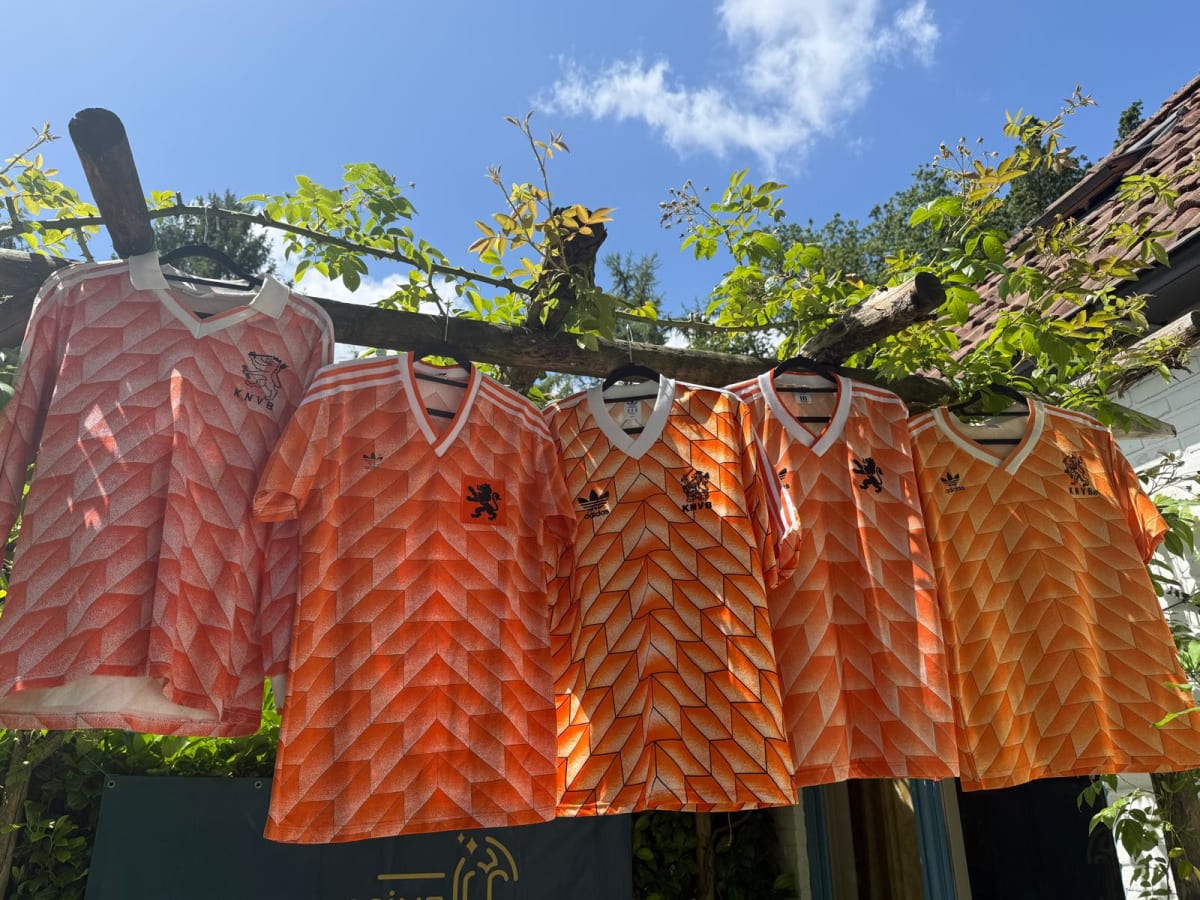
Ask a room full of collectors to name the greatest football shirt of all time and the Netherlands 1988 home shirt will win more votes than anything else. Frank Rijkaard, Ruud Gullit and Marco van Basten wore it to European glory, and the geometric orange pattern became one of the most recognisable designs in the history of the sport.
What far fewer people know is that there is no single Netherlands 88 shirt. Adidas produced it in factories across several countries, and each one made it slightly differently. Fabric, fit, tagging, the pattern itself: everything varies depending on where a shirt was made. For collectors, that turns one iconic design into a hunt for five distinct pieces.
We recently had five original versions together in one place: the South American, West German, Irish, English and Japanese productions. Seeing them side by side is the clearest way to understand why this shirt is so endlessly collectable.
Why One Shirt Became Five
In the late eighties Adidas did not operate the centralised global supply chain it does today. Production was licensed and distributed regionally, with factories in different countries manufacturing for their own markets. A shirt sold in Ireland was made in Ireland; a shirt sold in Japan was made in Japan.
Each factory worked from the same design brief but used locally available fabrics, local machinery and local tagging conventions. The result is that the same shirt, from the same year, can feel and look noticeably different depending on which country produced it.
This was completely normal at the time and nobody thought much of it. Four decades later, it has created one of the most interesting collecting puzzles in the hobby.
Reading the Differences
When you place several versions next to each other, the differences become obvious. These are the areas where they separate.
The Pattern
The famous geometric print is not identical across versions. The scale of the shapes, the sharpness of the edges and the depth of the orange all shift between factories. Some versions carry a bolder, higher contrast pattern; others are softer and more washed out, even when the shirt has barely been worn.
Because the pattern is the defining feature of this shirt, these variations are what collectors notice first. Two shirts can be equally original and still look clearly different from across a room.
The Fabric
Weight and texture vary considerably. Some productions used a heavier, denser polyester that holds its shape; others are markedly lighter and thinner. Run your hand across two versions and the difference is immediate.
This also affects how the shirts have aged. Heavier fabrics have generally survived better, while lighter versions are more prone to thinning and colour loss over the decades.
The Collar and Cuffs
Collar construction is one of the most reliable ways to tell versions apart. The height of the collar, the stiffness of the ribbing and the way the trim is applied all differ. Cuffs vary in the same way, with some versions using a tighter knit than others.
The Tagging
This is where a shirt tells you where it was born. Wash tags state the country of manufacture, and the layout, wording and languages printed on them differ per region. The main brand tag varies too, in size, stitching and placement.
For anyone verifying a Netherlands 88, the tags are the single most important thing to examine. They are also the first thing a serious seller should be willing to photograph.
The Badge
The KNVB crest and the Adidas trefoil are applied differently across versions. Embroidery density, thread colour and the exact positioning on the chest all shift slightly. On some versions the crest sits marginally higher or is fractionally larger than on others.
The Five Versions
Laid out from left to right, the five shirts we brought together were the South American, West German, Irish, English and Japanese productions.
South American Production
The rarest of the group in European collections, simply because far fewer made the journey across the Atlantic. These were produced for a different market entirely and turn up in Europe only occasionally, usually through collectors with contacts in the region.
West German Production
Made in the country hosting Euro 88, and for many the definitive version. The tagging carries the West German designation, which fixes it firmly in a specific political moment. Germany reunified in 1990, so a West German tag is a small piece of history in its own right.
Irish Production
Adidas ran significant manufacturing in Ireland during this period, supplying much of the European market. Irish made shirts are among the more commonly encountered versions in the UK and Northern Europe, though good condition examples are becoming harder to find.
English Production
Produced for the British market and typically found in the UK. As with the Irish version, distribution meant these surfaced regularly in Britain and Northern Europe.
Japanese Production
Japanese manufacturing from this era has a strong reputation among collectors, and shirts from that market often show excellent construction quality. Japan's football culture also means many were kept carefully rather than worn, so surviving examples can be in remarkable condition.
Which Version Should You Collect?
There is no correct answer, and that is part of the appeal.
Some collectors chase the version that matches what the players actually wore in the tournament. Others go for whichever production was sold in their own country, because that is the shirt they remember from shop windows as a child. Plenty simply buy the best condition example they can find, whatever the origin.
And then there are the completists, who want all five. Given how differently each version has aged and how uneven their survival rates are, assembling the full set is a genuine long term project rather than a shopping trip.
What to Check Before Buying
The Netherlands 88 is among the most reproduced shirts in existence, so caution is warranted. A few things to insist on.
Ask for clear photographs of both the wash tag and the brand tag. These identify the production country and are where most reproductions fail. Look closely at the pattern: reproductions frequently get the scale or the shade of orange slightly wrong, and once you have seen originals the difference becomes obvious.
Check the fabric weight in the photographs and ask the seller to describe how it feels. Modern reproductions almost always use lighter, smoother polyester than any of the original productions.
Above all, buy from someone who can explain which version they are selling and why. A seller who knows they have an Irish made example rather than simply a Netherlands 88 is a seller who has done the work.
A Design That Earned Its Reputation
Nearly forty years on, the Netherlands 1988 shirt still looks modern. It has been reissued, imitated and referenced endlessly, and no version has matched the original.
That it exists in five distinct forms only adds to the fascination. One design, one summer, one unforgettable team, and five different factories each leaving their own mark on it. For collectors, that is as good as it gets.